
Data Centres, Water, and the Future of Sustainable Infrastructure
The headlines are everywhere: “Alberta doubling down on AI data centres with new mandate for utilities minister” – Globe and Mail
“What will the AI data centre boom mean for Canada?” – The Narwhal
“Data centre progress could bolster slumping natural gas sector” – Calgary Herald
In Alberta, the push to build these centres includes a $70B project proposed by O’Leary Ventures, Wonder Valley AI Data Wonder Valley Master Plan. Image: O’Leary Ventures. Centre Park (Phase 1), currently under government review. Though one of the larger centres, Wonder Valley would not be the first in Alberta—many centres already operate in the province and continue to be approved (e.g., the Blindman Industrial Park AI Data Centre).
While Alberta has an A I Data Centres Strategy (2024), critical questions remain: Where should these centres be located? How will they fit with existing industries? What are the implications for water and energy use? This article highlights some of the challenges data centres present, along with potential paths forward.
What Is a Data Centre?
A data centre is a facility of one or more buildings housing centralized, computing infrastructure (e.g., servers, storage, and networking equipment) needed for processing, storing, and distributing massive amounts of data across public and private networks. Large data centres can hold several exabytes of memory—the equivalent of several million desktop computers. Administration buildings and dedicated heat/power plants might also be part of a data centre facility, as is the case with the 120-acre Blindman project in Red Deer County.
By combining large memory capacity with superfast processing speeds, data centres support governments, businesses, and consumers across a broad range of applications. Indeed, though many of us don’t even realize it, we interact with data centres every day—whether using cloud storage for photos, enabling AI assistants, securing cryptocurrency transactions, or defending against cyber threats. As digital dependence grows, so too does the demand for these critical facilities. But there’s a catch: data centres are resource intensive. Alongside electricity and land, water is one of their most critical inputs.
The Water Challenge
Large data centres can consume up to 19 million litres of water per day, equivalent to the daily use of 70,000 southern Albertans. The bulk of this water is used for cooling the heat generated by processors, which can be significant. A large centre, for example, can generate up to 300 megawatts of heat—roughly equivalent to the heating demand of a mid-sized community like Red Deer.
In order to maintain efficient operations and prevent overheating of equipment, the ASHRAE Thermal Guidelines for Data Processing Environments recommends operating temperatures of 18-27°C. To stay within this range, particularly in regions characterized by higher temperatures/hot summers (like southern Alberta), many data centre operators favour water-based cooling systems, which are more efficient and cost-effective than air cooling systems.
However, in drought-prone regions like southern Alberta, water resources are already stretched by agriculture, municipalities and industry. New industrial water users such as data centres, raise difficult questions and trade-offs. Rocky View Council, for example, recently voted 6-1 to reject a plan for an AI data centre complex over water supply concerns (CBC). With farmers having already faced irrigation cuts in 2023 due to drought, local leaders questioned the centre’s dependence on municipal water and its long-term impacts on rural communities.
Lessons Learned from Other Regions: The Case for Water Reuse
Reflecting on the Rocky View County dilemma, it is useful to explore how other regions address similar concerns. In some cases, water shortage is addressed through evolving policy and regulations, and collaboration with industry and stakeholders.
Quincy, Washington offers a powerful precedent. Two decades ago, Quincy invested in advanced wastewater treatment and water reuse—making treated effluent available for irrigation. Those early investments laid the foundation for economic transformation.
Today, Quincy hosts 26 data centres—including Microsoft, Yahoo, and Intuit—which rely on reclaimed water for cooling. These data centres now provide value-added services that directly benefit agriculture. When strategically positioned near agricultural hubs and supported by integrated water reuse and energy infrastructure, they become enablers of both digital and agricultural innovation:
- Data Collection and Sharing – crop and equipment
- Precision Agriculture – optimizing inputs and yields
- Predictive Maintenance – equipment performance tracking
- Research and Development – aggregating data to identify trends
Alberta can do the same. By recognizing how data centres support both digital and agricultural economies, we can ensure growth that complements—not competes with—agribusiness.
Local Innovation: Shepard Energy Centre
We don’t need to look far for local examples. In Calgary, the Shepard Energy Centre uses reclaimed water from the Bonnybrook Wastewater Treatment Plant, showcasing Alberta’s leadership in municipal water reuse. This project proves that power generation and water scarcity can coexist—with the right infrastructure.
Alberta’s Opportunity: Blue Belts
Much like a green belt protects natural landscapes, blue belts protect water supplies and could safeguard Alberta’s water future.
A blue belt is a planned network of raw water pipes, wastewater pipes, and reclaimed water pipes. These corridors support the full water cycle, from supply to reuse, and align with long-term infrastructure plans for transportation, utilities, and economic development.
For example, Calgary has recently advanced major wastewater infrastructure work (e.g., upgrades and expansions at the Bonnybrook and Fish Creek wastewater treatment plants) that demonstrate how municipal-scale reuse and servicing can support broader regional needs. By aligning transportation, critical infrastructure and amenities, contemporary municipal critical infrastructure and amenities, contemporary municipal play communities that are no longer tied to a dense urban core. Taking sustainable development a step further, the alignment of transportation and water-related infrastructure to decentralized hubs can support a multitude of compatible uses. Blue belts emanating from decentralized utility hubs allows for the installation of modern piping systems, safer water supplies and reduced environmental impact.
In Alberta, a blue belt could:
- Provide predictable, sustainable supplies for data centres and other high-tech industries.
- Reduce the need for each facility to install its own costly treatment system.
- Help municipalities balance agricultural, urban, and industrial demands more effectively.
Blue belts aren’t theoretical, Quincy, Orange County, and Singapore have already adopted similar models.
What Needs to Happen
To position Alberta as a sustainable data centre destination, we must:
- Plan for the long term. Municipal leaders must embed water stewardship into permitting and economic development strategies.
- Hold industry accountable. Developers must consider reuse and efficiency in their designs.
- Deploy proven technologies. Membranes, reverse osmosis, and ion exchange are mature solutions; the challenge is integration.
- Collaborate across sectors. Organizations like the Bow River Basin Council (BRBC) can convene municipalities, farmers, industry, and researchers to explore issues, challenges, and potential pathways forward. The BRBC’s forums and workshops, for example, provide excellent opportunities to share information and exchange ideas.
Alberta Has the Talent
There are no silver bullets—but Alberta has the tools. Companies like ClearBakk ALSYS Group have decades of experience designing modular water treatment systems, reclaiming wastewater, and delivering industrial water reuse for oil and gas, power plants, and remote facilities. The same expertise can be applied to data centres—ensuring they don’t just consume water but fit within a circular and resilient system.
A Balanced Future
Data centres are here to stay. With smart planning and strategic investment, Alberta can grow its tech economy while sustaining its agricultural roots. By embracing reuse infrastructure, integrated planning, and local expertise, we can ensure data centres contribute to—not compete with—a thriving, water-conscious Alberta.
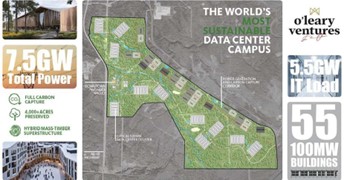
Wonder Valley Master Plan. Image: O’Leary Ventures.
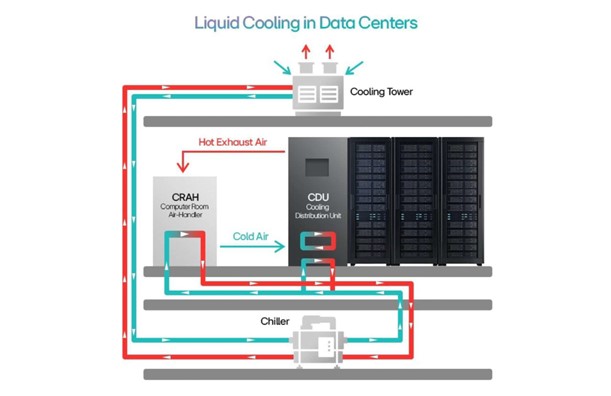
Liquid-cooled systems use water or specialized coolants for superior heat absorption and temperature control. Graphic: LG Electronics.
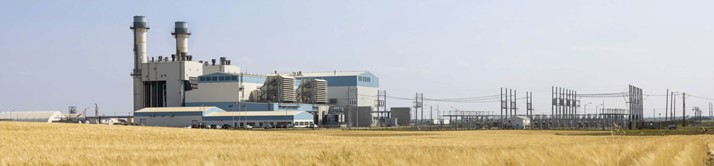
The Shepard Energy Centre integrates reclaimed water from Calgary’s Bonnybrook Wastewater Treatment Plant, reducing reliance on potable water sources. Photo: Enmax.
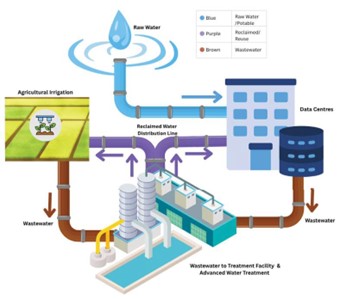
Blue belt corridors support the full water cycle, from supply to reuse, and align with long-term infrastructure plans for transportation, utilities, and economic development. Graphic: ClearBakk ALSYS Group.
Co-authors
- Bill Berzins
Director, Aquen Canada Inc. ClearBakk ALSYS Group
www.aquen.ca - Yatin Pandit
Water Treatment Advisor-Global Director ClearBakk ALSYS Group
yatin.pandit@alsys-group.com - Nathaly Garcia
Technical Sales Coordinator ClearBakk ALSYS Group
nathaly.garcia@alsys-group.com