
Public Safety and the Environment: Solving the Road Salt Dilemma
When the Bow River Basin Council (BRBC) was established as a Watershed Planning and Advisory Council under Alberta’s Water for Life Strategy shortly after 2000, it brought together the people and processes necessary to help make the difficult tradeoffs between social, economic and environmental interests. Today, the BRBC’s municipal members are faced with very difficult tradeoffs: Do we increase the use of road salt to further reduce accident frequency? Do we reduce the amount of salt used to protect the aquatic environment? Does road salt in runoff limit the reuse of stormwater as we enter extended periods of drought with less water available for a healthy economy?
Stormwater reuse has been a key issue for the Calgary Metropolitan Region Board (CMRB) since its initial studies supporting a Regional Servicing Plan began in 2019. At that time, the CMRB published a Stormwater Reuse Backgrounder that identified water reuse case studies around the world. The CMRB correctly identified stormwater reuse as a potential solution for reduced water availability under climate change scenarios (and, in fact, stormwater runoff was already contributing to the Bearspaw and Glenmore reservoirs).
More than 5 million tonnes of salt are applied to roads across Canada resulting in elevated levels of sodium and chloride in soils, vegetation and the aquatic environment. The reduction of salt in runoff is a priority for the Federation of Canadian Municipalities, which has a Green Municipal Fund Program supporting studies to reduce salt impacts.
Undoubtedly, salt application benefits commuters during icy conditions. Studies across the US have shown that the application of salt can reduce accident frequency by 85%. A 10% improvement in the surface friction of a road can yield a 20% reduction in crashes. And on four-lane roads, before-and-after analysis has shown a 93% reduction in crashes after de-icing. Calgarians benefit immensely from The City’s Snow and Ice Control (SNIC) Policy.
On the flip side, road salt increases chloride concentrations in runoff. Chloride is a highly soluble and mobile ion that spreads rapidly throughout a water body. It is also toxic to wildlife and can be incredibly persistent because nothing naturally breaks down chloride in the environment. High chloride levels can also inhibit the growth/reproduction of aquatic species, impact food sources, and disrupt amphibian osmoregulation. In addition, high chloride levels can lead to oxygen depletion by creating an oxygen-deficient layer that is harmful to aquatic life. A comprehensive 5-year scientific assessment published by Environment and Climate Change Canada determined that, in sufficient concentrations, road salts pose a risk to plants, animals and the aquatic environment.
Excess salt in the environment also impacts riparian landscapes. Salinity affects almost all aspects of plant development including germination, growth and reproduction. High salinity can cause ion toxicity, osmotic stress, nutrient deficiency and oxidative stress on plants, thereby limiting water uptake. There are also impacts on agrarian landscapes. In Eastern Canada, downstream landowners have successfully been awarded compensation for crop losses, the cost of soil/plant analysis, and for the diminution of property value resulting from road salt contamination. Closer to home, Alberta’s Ministry of Environment and Protected Areas has monitored water quality in Fish Creek at its mouth to the Bow River for 20 years through its Tributary Monitoring Network. Although sample frequency is too limited to yield a conclusive trend, 10% of samples analyzed from December through to February showed chloride levels exceeding Alberta Water Quality Guidelines for acute toxicity (see Table 1). Perhaps equally problematic is the fact that chloride measurements often exceed levels considered acceptable for long-term chronic exposure. Acute guidelines are never to be exceeded; chronically high chloride levels can cause permanent damage to the ecosystem.
| Station Location |
Sample Comment |
Sample Date & Time |
17206 CHLORIDE DISSOLVED mg/L |
2003 CHLORIDE DISSOLVED mg/L |
Alberta Guideline Acute |
Alberta Guideline Chronic |
| AB05BK0070 FISH CREEK, #8 NEAR THE MOUTH |
Chinook weather conditions causing street runoff. | 3/26/2002 15:15 |
687 | 640 | 120 | |
| sampled from chiseled hole; sunny; calm; over ice flow | 3/14/2018 13:30 |
690 | ||||
| picked a hole. pH probe is suspect. | 3/3/2021 14:30 |
610 | ||||
| overcast; sampled from open lead | 12/4/2018 12:05 |
410 | ||||
| Sunny, calm, augered hole | 3/9/2022 12:45 |
390 |
Table 1. Chloride levels at the mouth of Fish Creek into the Bow River.
So the question arises “Could the elevated chlorides in Fish Creek be naturally occurring?”
The Fish Creek Watershed Association rece-ly published its State of The Watershed Report, confirming that water quality exiting the upper reaches of the watershed met aquatic and irrigation water quality guidelines. It appears that outside Calgary city limits, Fish Creek water quality meets guidelines.
Further downstream, Fish Creek absorbs runoff from surrounding neighbourhoods and Calgary’s expanding road network. In 2020, seeking to understand the impact of increased salt content in stormwater runoff from these sources, researchers from The University of Calgary analyzed the quality of the runoff from Anderson Road and the communities of Cedarbrae and Braeside. They discovered that levels of Total Dissolved Solids (primarily chloride and sodium) were many times higher than Alberta’s acute toxicity limits.
As with any environmental issue, the first step towards solving the problem relies on a basic understanding of the sources of elevated chlorides, in this case likely related to the application of snow and ice control formulations on the streets upstream. Over the years, The City has used a number of formulations to improve road safety. Depending upon road conditions, these formulations have included pickled gravel, granular road salt, calcium chloride, salt brine and beet brine.
Potential concerns emerge, however, when looking deeper into the composition of some of these formulations. Safety data available from suppliers indicates that the aquatic toxicity of some of the additives is unknown (e.g., anti-caking compounds including sodium hexacyanoferrate and ferric ferrocyanide). While much is known about the potential harm from ingestion of excess quantities of salt, less is known about the effect of road salt additives within the aquatic environment.
In terms of solutions, the “solution to pollution is dilution” approach to chloride and sodium exceedances has limitations. For example, dilution via the use of potable water for irrigation, especially given climate change and our unpredictable rainfall, burdens Calgary’s drinking water infrastructure and is subject to water use restrictions (especially during El Niño cycles). As well, relying on high precipitation during the spring freshet to temporarily flush the problem downstream does little for water quality during a drier fall season. Neither solution reduces the problem of acute salinity in Fish Creek.
Because these traditional solutions may not be sustainable during droughts, alternative treatment methods may be required prior to reusing water exiting Calgary’s storm drain system. Fortunately, alternative treatment options are emerging, including electrodialysis. In addition to producing clean water (i.e., water that may be suitable for irrigation or potable use), electrodialysis can be “tweaked” to produce a more concentrated brine. Since Calgary already utilizes a 22% brine solution for its SNIC program, a concentrated brine from a dialysis system has the potential to be reapplied on city roads. Cleaner stormwater and reusable brine might represent a win-win for public safety and a cleaner environment.
By building on CMRB’s identified solution of stormwater reuse under climate change scenarios, reviewing and improving policies (e.g., The City of Calgary’s recent Snow and Ice Control Policy Review), and testing alternative treatment methods, scientists and engineers may soon find ways to lessen the impacts of road salt on urban ecosystems while providing clean stormwater for municipal water supplies.
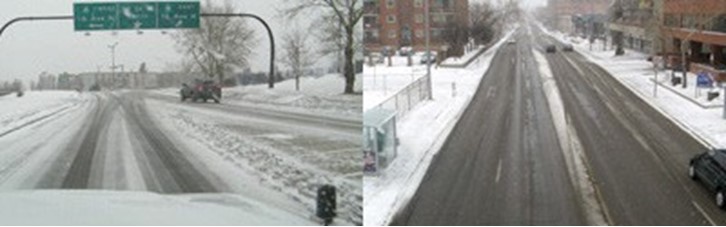
Before and after photo of de-iced roadways. The City of Calgary only uses sodium chloride and calcium chloride. Roads salts used for snow and ice control may be solid or liquid brines. Photo: The City of Calgary.
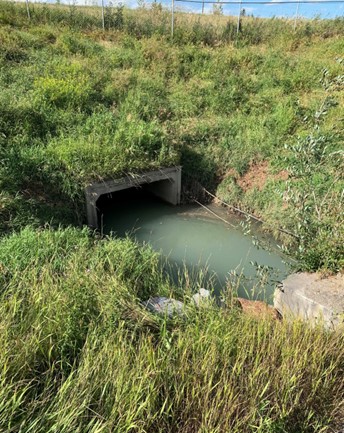
Runoff from Anderson Road, Calgary. Photo: Bill Berzins.
Author
Bill Berzins Bill Berzins, M.A.Sc. P.Eng.
Aquen Canada Inc., BRBC Chair: 2000 – 2009
billberzins@shaw.ca