
AQUEN utilizes world-class forecast and simulation tools to improve your access to water, reduce deficits and drought-proof your water supply.
There are a number of tools that can be applied in order to ensure an adequate supply of water during the warmer-drier winter-spring caused by the El Nino cycle. First and foremost, a risk assessment using Web.bm, WRMM or SSROM can highlight the probability of deficits and potential for withdrawal restrictions. Secondly, a Water Shortage Response Plan is a key tool for identifying the series of responses to overcome escalating levels of water restrictions. Thirdly, a Temporary Transfer or assignment from a more senior licensee may be available on a short-term basis to help more junior license holders that may be subject to seasonal restrictions or cut-offs. Fourthly, achieving certification as a Water Managed Site can protect a user during the initial levels of watering restrictions within areas serviced by a municipal provider. Finally, a permanent License Transfer may be available from a license holder that has implemented measures to conserve water and set aside a portion of the allocation for transfer in accordance with the Matters and Factors identified within the Approve Water Management Plan for the South Saskatchewan River.
The droughts of 1992 and 2001 combined with the floods of 2005 and 2013 have made it clear that we cannot rely solely on current modeling and management approaches to meet the goals of Alberta’s Water for Life strategy (i.e., a safe, secure drinking water supply; healthy aquatic ecosystems; and reliable, quality water supplies for a sustainable economy). This article explores how we might increase water availability in the South Saskatchewan River Basin (SSRB).
Background
In 2006, the Government of Alberta released the Approved Water Management Plan for the SSRB. The plan was intended to “provide guidance to decision makers and act as a foundation for future water management planning of sub-basins in the SSRB.” Moreover, it “recognizes and accepts that limits for water allocations have been reached or exceeded” in three of the SSRB’s four sub-basins, and that the limit of the water resource “will be reached” in the fourth sub-basin.
In 2018, the Bow River Basin Council led a review of the implementation of the SSRB plan. The final report, prepared by Basin Advisory Committees from all four sub-basins using the most recent data available at the time, showed that approximately 62% of the SSRB’s surface water is allocated (based on mean natural annual flow and cumulative volume of active allocations). While this does not represent actual water use in the SSRB, it does reflect the maximum volume of licenced water that could be used by various sectors (e.g., municipal, irrigation, industrial), and that that maximum volume represents a significant portion of the SSRB’s surface water.
In July of this year, the Auditor General of Alberta prepared an audit on whether the Department of Environment and Protected Areas has effective systems to manage water resources in Alberta. The audit noted that “Alberta could face more severe and frequent droughts.” The audit concluded that the department “lacks effective processes to manage surface water allocation and use. And public reporting on surface water and the outcomes of surface water management is lacking.”
Going forward, how can we meet the goals of Water for Life? What ‘effective processes’ are needed? And, while there is a need to develop additional reservoir capacity, how might we better leverage existing reservoirs, particularly in times of drought and given expectations that allocations in the SSRB will be more fully utilized in the future?
Modeling
Current models, e.g., SSROM and WRMM, are useful tools in managing water demand, these models do not support supply-side optimization of available reservoir storage (i.e., deciding when, where, and how much water to hold and release in the system). Moreover, the current decision-making processes associated with modeling input and output warrant review. We need, in short, robust ‘supply/demand-side’ management processes and tools – processes that are more transparent, and tools that are updated and more useful for managing storage and release volumes.
Uncertainty and Assumptions
Many variables are considered in reservoir operations. These may include, for example, prediction of runoff conditions over the next few months when managing droughts, or for the next few days when managing floods. Predictions require data, algorithms, and software. However, due to uncertainties related to required inputs (e.g., weather forecasts and related soil conditions), predictions are not 100% accurate.
Hence, we can say that managing water resources on a basin level also has a stochastic component that relies on utilizing random variables that are often defined by probability distribution functions. Put simply, we can guess the likely range of incoming variables, but we cannot pinpoint their single values with certainty.
To address this uncertainty, our traditional approach in Alberta has been to explore options based on selected cases of past conditions. One or more ‘representative years’ from historical records are chosen, and computer models are then used to explore the effects of different river diversions and reservoir operations on water availability during those years. Decision makers can then discuss the results and collectively decide on the best options. This is a useful, evidence-based approach for decision making and building consensus. It is also the approach taken in a recent drought modeling exercise in Alberta, which assumed the runoff conditions of a previous dry year (2001), with small modifications that delayed the onset of runoff and reduced runoff conditions in the Bow River Basin by 10%.
Yet, importantly, how do we know that a single historical dry year represents our current conditions? Each year is different, and it seems those assumptions may have been too conservative when irrigators were instructed to expect only 50% of their allocation in 2024; after a wet June, it appears more water-intensive crops might have succeeded after all.
While hindsight is 20/20, the point made here is this: assumptions used in modeling, and the decisions that are based on that modeling, can critically impact users. This past spring and summer, decisions related to water availability critically impacted many farmers. In a billion-dollar industry supplying a nutrient-deficient world, what could have been done differently?
In addition to improving modeling capabilities to optimize water availability (i.e., storage and release volumes), modeling results need to be open, and subjected to checks and balances – a best practice currently supported in academic research. Analyzing model output is not trivial and requires expertise, and decisions based on this output can have serious implications for municipalities, irrigators, businesses and ecosystems. Open sharing of modeling assumptions and results, and a system of checks and balances, are therefore essential to a more collaborative – and possibly more effective – approach.
The Importance of Rule Curves
Reservoirs are built to help combat droughts and floods. For droughts, excess runoff during wet seasons is stored and released later in the year when natural runoff is insufficient to meet the downstream water requirements.
The first attempts to simulate the operation of reservoirs using a computer involved the application of the so-called “Standard Operating Policy (SOP),” which releases water in dry seasons as needed to help meet downstream water demands and provide adequate river maintenance flows.
The thin blue line in Figure 1 shows the results for three consecutive years simulated using the SOP. Note that this “storage drawdown curve” has a similar shape in years when storage was either full or half-full at the start of the dry season.
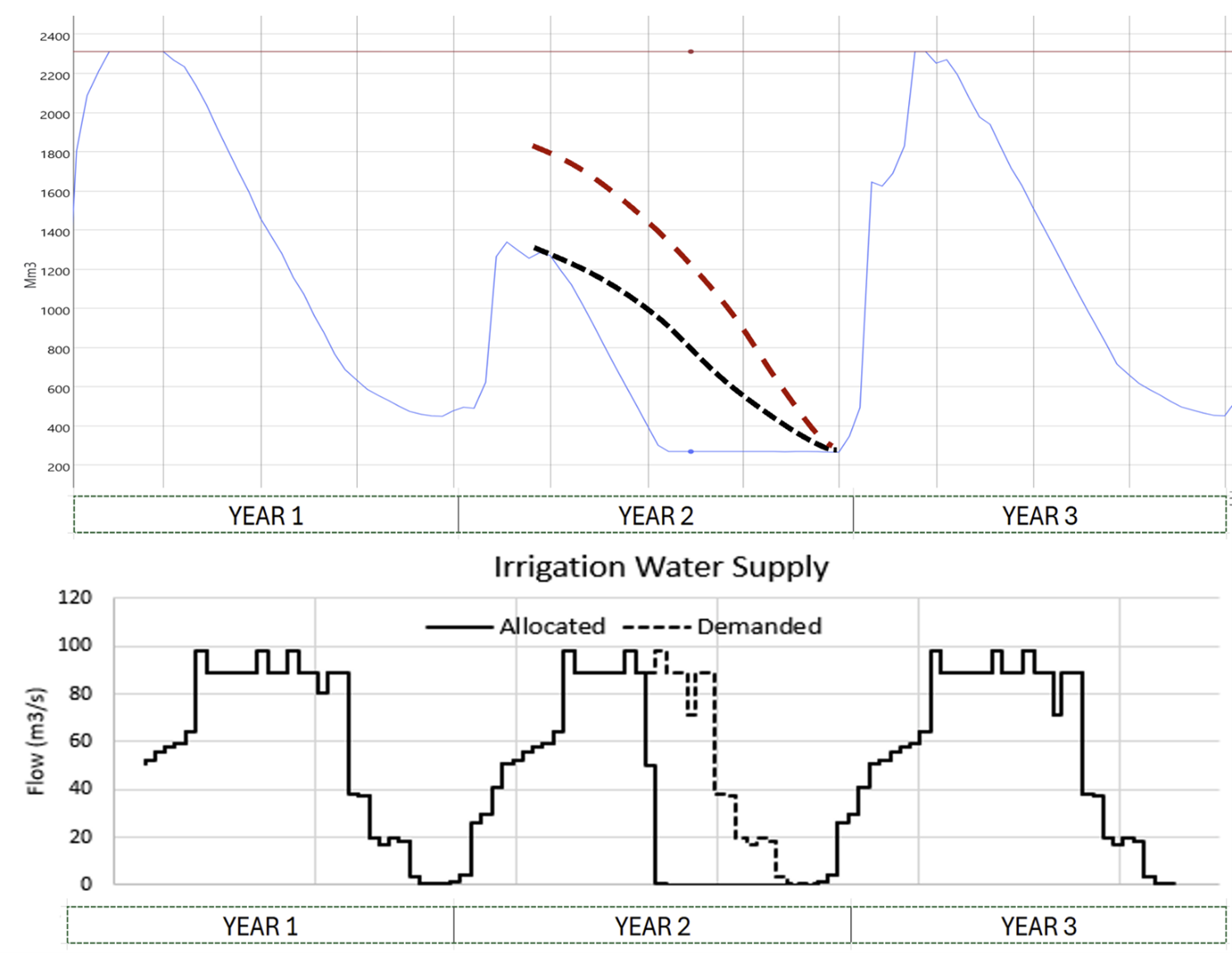
Figure 1. Simulated storage levels resulting from Standard Operating Policy
Notably, it is much easier to manage storage that is full at the start of a dry season. When it is not full, as shown in the second simulated year in Figure 1, the storage can run out prematurely as shown in the bottom part of the graph, where water demands (dashed line) and the supplied amount (solid line) show 100% deficits (in other words, zero water supply) over more than 10 consecutive weeks. A crop failure would result under such conditions.
This traditional approach does not respond well under highly variable water supply conditions. In India, for example, made-in-Alberta tools are solving the problem using advanced modeling that accommodates both extreme flood conditions and prepares the system for not one but two growing seasons. This is accomplished by modifying the rule curves depending upon the severity of the drought. In addition, the response of the river system to water releases is more closely modeled to mimic the dynamic response of the river to the influx of more water, particularly within the shallow river systems seen on the prairies.
Much like Machine Learning algorithms that allow computers to play chess, we should expect the optimization algorithms used in river basin models to give us the best water allocation for any assumed hydrological conditions. Computers can quickly examine millions of combinations of possible reservoir releases and find the best solution, similar to how they identify the best chess moves.
The use of historical (known) runoff conditions as model input should produce better reservoir operations than the actual historical operation. However, this is not always the case.
For example, the simulation results in Figure 2 show the Oldman Reservoir, which remained empty for more than six months in 2001. Downstream water supply was prioritized until the reservoir was completely dry. Here, the historical operation (dashed line) seems to have managed the storage much better than the model. Kudos to the dam operators, but then the logical question is “How do operators benefit from relying on model results that do not improve on the historical operations”? Optimization offers such improvement, and it is the subject of the University of Alberta project mentioned above.
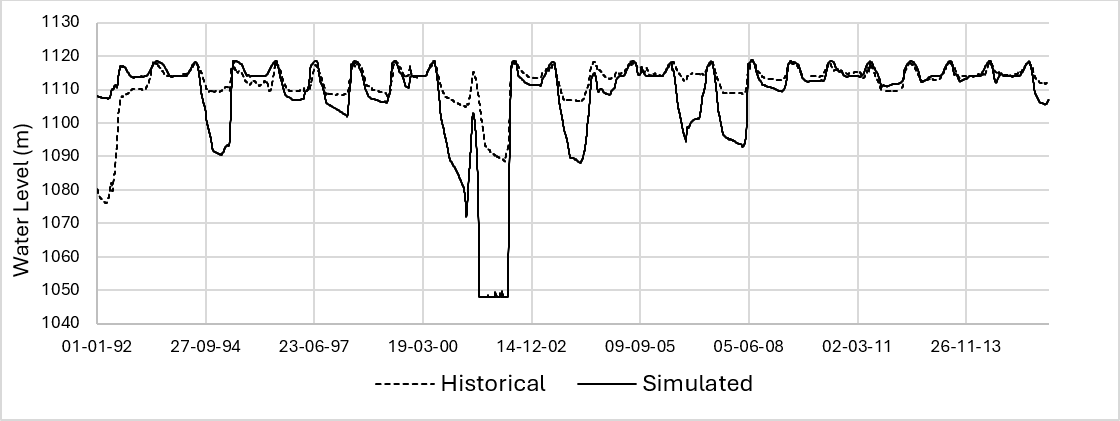
Figure 2. An Example of simulated and historical levels of the Oldman Reservoir
The near-drought of 2024 has taught us we need to move more quickly to the application of advanced modeling using optimization algorithms across the entire SSRB. The prospect of a large irrigation project within the Special Areas combined with announced capital investments in downstream irrigation infrastructure in Alberta will increase pressure on our limited water supply.
While we continue to model scenarios based on the past to help us improve water sharing, we need to increasingly focus on the application of more powerful tools to optimize the management of our storage system.